Choosing between Optimizely and VWO as your core Optimizely vs VWO experimentation platform isn't a trivial decision — it shapes how fast your team can ship tests, how confidently you can interpret results, and whether your program scales or stalls. This head-to-head comparison breaks down features, statistical engines, pricing models, and ideal team profiles so you can make a defensible, data-informed choice in 2026.
What Separates the Optimizely vs VWO Experimentation Platform Decision?
On the surface, Optimizely and VWO both let you run A/B tests, multivariate experiments, and personalization campaigns. Dig deeper and the two platforms diverge sharply in philosophy, architecture, and target audience. Optimizely was built for engineering-led experimentation programs at scale — think hundreds of concurrent experiments across web, server-side, mobile, and feature flagging pipelines. VWO was designed to make conversion rate optimization accessible to marketers who can't or won't write code for every test.
That foundational difference cascades into everything: how experiments are instrumented, how statistical significance is calculated, how results are stored and queried, and — critically — how much your team needs to grow to use the platform effectively. Neither choice is objectively wrong. Both are wrong for the wrong team. Understanding which camp you're in now, and which camp you're building toward, is the real decision.
"The most expensive experimentation platform mistake isn't overpaying — it's buying enterprise infrastructure before your organization has the processes to fill it, or capping growth with a tool you'll outgrow in eighteen months."
The comparison below maps each platform against six dimensions that matter most when scaling a testing program: statistical rigor, developer dependency, visitor/test capacity, integration depth, pricing transparency, and support quality. Before you read the verdict, it helps to understand what each platform actually looks like in practice.
Optimizely: Enterprise Experimentation at Scale
Optimizely (now part of the Optimizely One suite) is positioned squarely at mature experimentation programs operating inside large organizations. Its flagship product, Optimizely Feature Experimentation, decouples feature rollouts from code deployments through a robust SDK ecosystem covering JavaScript, Python, Java, Go, Swift, Kotlin, and more. This means product and engineering teams can run server-side experiments without touching a visual editor — a non-negotiable requirement once you're testing checkout flows, search ranking algorithms, recommendation engines, or any experience that lives below the DOM.
The platform's statistical engine supports both frequentist and Bayesian approaches, with Stats Engine — the proprietary sequential testing framework co-developed with Stanford researchers — being the default for web experimentation. Stats Engine addresses the peeking problem by using always-valid confidence sequences, which means teams can check results continuously without inflating false positive rates. This is a significant advantage over naive fixed-horizon t-tests that many simpler tools still use by default.
Optimizely's data layer integrations are deep. Native connectors exist for major data warehouses (Snowflake, BigQuery, Redshift), CDPs, and analytics platforms. Experiment data can flow into your existing data stack rather than living in a silo, which matters enormously when analysts want to slice results by customer segment, lifetime value tier, or cohort. The platform also handles mutual exclusion and traffic allocation across overlapping experiments automatically — a requirement that becomes urgent once you're running more than a handful of simultaneous tests.
Where Optimizely struggles is accessibility and cost. Implementation typically requires dedicated engineering resources. The visual editor exists but is not the primary interface. Pricing is custom and enterprise-contracted — industry practitioners report annual contracts commonly ranging from $50,000 to well over $200,000 depending on monthly tracked users and feature tier. For teams with fewer than two or three dedicated experimenters and no engineering bandwidth allocated to the testing program, Optimizely's power often goes unused while its cost is fully felt.
That said, for organizations serious about building a mature experimentation program team structure, Optimizely's architecture rewards investment. Its audit trails, hypothesis management, and metrics library make governance tractable as experiment volume grows. Programs running fifty or more concurrent experiments per quarter will find the infrastructure earns its cost.
VWO: Accessible Testing for Growth-Stage Teams
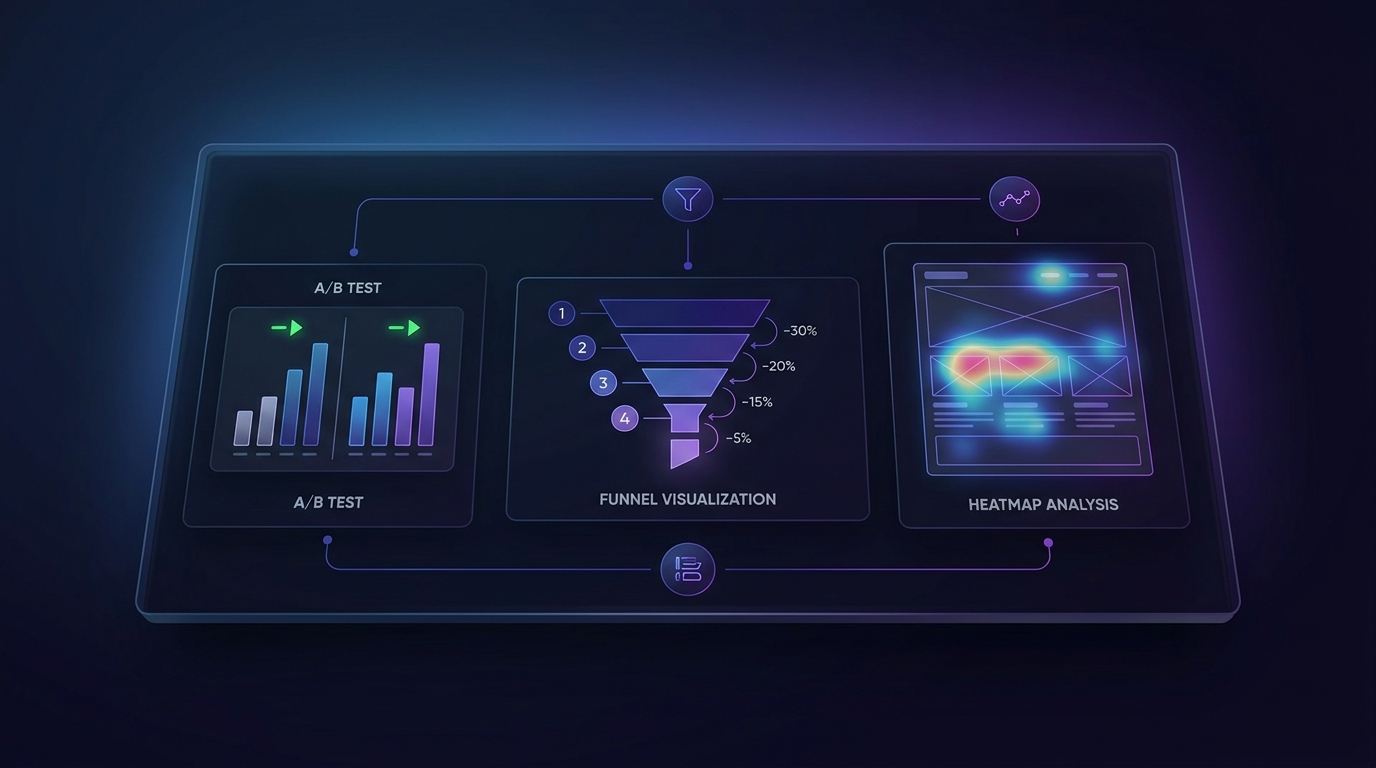
VWO (Visual Website Optimizer) has evolved substantially from its origins as a simple visual A/B testing tool. The 2026 platform bundles experimentation, session recordings, heatmaps, funnel analytics, and personalization into a unified suite branded as VWO Testing, VWO Insights, and VWO Personalize. This all-in-one approach is genuinely valuable for teams that want behavioral data and experiment data living in the same interface without stitching together three separate tools.
The visual editor remains VWO's strongest differentiator for non-technical users. Marketers can set up point-and-click tests on most standard pages without writing a line of code, which shortens the cycle from hypothesis to live experiment dramatically. For programs that are still building internal buy-in and need to ship quick wins to demonstrate ROI, this speed matters more than architectural elegance.
"Teams that can ship ten low-fidelity tests per quarter will consistently outlearn teams that ship two methodologically perfect ones — at least until experiment quality becomes the binding constraint on learning velocity."
VWO's statistical engine has improved significantly and now offers Bayesian testing as a default option alongside frequentist methods. The SmartStats engine provides probability-to-be-best metrics that are more intuitive for non-statisticians than p-values, reducing the frequency of misinterpreted results. That said, the platform's server-side and SDK capabilities, while present, are less mature and less widely documented than Optimizely's. Teams planning heavy server-side experimentation will hit friction faster.
Pricing is considerably more transparent. VWO publishes tiered pricing starting around $400–$500 per month for lower-traffic sites, scaling to custom enterprise contracts for high-volume programs. This predictability makes budget planning easier for growth-stage companies that haven't yet secured a large experimentation budget line. Many practitioners report that VWO's mid-tier plans represent strong value for programs running five to twenty experiments per month on primarily front-end experiences.
VWO also integrates cleanly with Google Analytics 4, Mixpanel, Segment, Shopify, and common email platforms. The integration breadth is solid for a marketing-centric stack, though data warehouse connections are less flexible than Optimizely's. If your analysts live in SQL and expect raw experiment assignment data in Snowflake, you will need to build that pipeline yourself or accept VWO's native reporting as your primary results layer.
Direct Comparison: Six Critical Dimensions
The table below distills the most consequential differences for teams evaluating both platforms. Scores reflect practical capability as experienced by mid-to-large experimentation programs in 2026, not marketing positioning.
| Dimension | Optimizely | VWO | Advantage |
|---|---|---|---|
| Statistical Engine | Sequential (Stats Engine) + Bayesian; frequentist available; co-developed with academic researchers | Bayesian (SmartStats) + frequentist; solid for standard tests; less flexibility for custom metrics | Optimizely |
| Server-Side & SDK Depth | Best-in-class SDK coverage (12+ languages); feature flags; mutual exclusion; edge delivery | Server-side available; fewer SDKs; less mature documentation; better suited to front-end use cases | Optimizely |
| Visual Editor & No-Code Testing | Present but secondary; engineering-first workflow assumed | Primary interface; point-and-click test creation; strong for marketer-led programs | VWO |
| Pricing Transparency | Custom enterprise contracts; no published pricing; commonly $50K–$200K+ annually | Published tiered pricing; starts ~$400–$500/month; enterprise plans negotiated but baseline is visible | VWO |
| Data Warehouse & Analytics Integration | Native Snowflake, BigQuery, Redshift connectors; raw event export; data-stack-first design | GA4, Mixpanel, Segment integrations; warehouse export requires configuration; reporting mostly in-platform | Optimizely |
| Behavioral Insights (Heatmaps, Sessions) | Not native; requires separate tooling (Hotjar, FullStory, etc.) | Native session recordings, heatmaps, and funnel analysis included in suite | VWO |
No single platform dominates across every dimension. The tiebreaker is almost always team composition and experimentation program maturity — two variables that deserve an honest assessment before you sign either contract.
Verdict: Which Platform Wins for Your Team?
The clearest signal for choosing Optimizely is when your experimentation program has or is actively building engineering partnership. If tests regularly touch server-side logic, mobile app experiences, or feature flag workflows, Optimizely's SDK architecture becomes load-bearing infrastructure rather than a nice-to-have. Programs at Level 3 or above on a standard experimentation maturity framework — running 50+ tests per year with dedicated analysts and a centralized hypothesis backlog — will extract genuine ROI from Optimizely's governance and data layer features.
Choose VWO when your program is marketer-led, front-end-focused, and needs to demonstrate business impact before securing larger budget and headcount. The all-in-one behavioral insights suite eliminates tool sprawl for smaller teams. If your analysts are primarily working inside GA4 and Looker rather than writing SQL against a warehouse, VWO's native reporting is sufficient and its onboarding time is dramatically lower. Many growth-stage e-commerce, SaaS, and media companies find VWO covers 90% of their testing needs at a fraction of Optimizely's cost.
A practical rule of thumb used widely across the industry: if you're running fewer than forty experiments per year and your primary experimenters are marketers or growth managers rather than engineers, VWO is likely the right fit. If you're running more than eighty experiments annually, have at least one dedicated experimentation engineer, and need results to flow into a centralized data warehouse for downstream analysis, Optimizely's architecture pays for itself.
One scenario where neither platform is the obvious winner: mid-stage programs (roughly 40–80 tests per year) with a mixed technical team. Here, hybrid stacks — using VWO for front-end marketing tests and a lighter feature flagging tool for product tests — sometimes outperform committing fully to either platform at a stage when requirements are still evolving.
How to Transition Between Platforms Without Losing Momentum
Switching experimentation platforms mid-program is operationally disruptive but manageable with the right sequencing. The two most common transitions are from VWO to Optimizely (as programs mature) and occasionally from Optimizely back to VWO (when organizations downsize their testing ambitions or centralize costs). Both directions share the same core risk: losing institutional knowledge stored implicitly in a platform rather than documented properly.
Start by auditing your experiment archive before any migration. Export every test result, hypothesis, winning variant, and implementation note you have. Experimentation platforms frequently store test history in formats that don't transfer cleanly, and rebuilding tribal knowledge from memory after a migration is a hidden productivity tax that hits new team members hardest. Store this archive in a dedicated knowledge base — Notion, Confluence, or a purpose-built experimentation repository.
Run both platforms in parallel for at least one full testing cycle (typically four to eight weeks) before fully deprecating the old one. This parallel period lets you validate that the new platform's tracking, assignment logic, and metric calculations produce consistent results on replicated tests. Discrepancies caught during parallel running are far less damaging than discrepancies discovered six months into a migration when institutional memory of the old system has already faded.
Re-instrument your primary metrics and guardrail metrics in the new platform from scratch rather than copying configurations. Metric definitions that were built as workarounds for a previous platform's limitations often don't make sense in a new architecture. Treating the migration as a metrics-quality audit typically surfaces measurement issues that had been quietly distorting results for months or years. Allocate a minimum of two to three weeks for this instrumentation work, more if your product surface area is large or your data layer is complex.
Finally, brief your key stakeholders before, not after, the transition. Experiment results displayed in a new interface look different even when the underlying methodology hasn't changed. Decision-makers accustomed to one platform's reporting format often misinterpret the new one without a brief orientation, which can erode confidence in the program at exactly the wrong moment. A short internal demo — thirty minutes, live examples — prevents a significant amount of confusion downstream.
Frequently Asked Questions
Is Optimizely better than VWO for enterprise companies?
Optimizely is generally the stronger choice for enterprise companies that run high experiment volumes, require server-side and SDK-based testing, and need raw experiment data to flow into a centralized data warehouse. Its statistical engine, mutual exclusion handling, and governance features are built for the complexity that enterprise programs generate. That said, enterprise teams with primarily front-end, marketer-led testing programs sometimes find VWO's suite covers their needs at meaningfully lower cost and operational overhead.
How does VWO's SmartStats compare to Optimizely's Stats Engine?
Both engines address the core limitation of naive frequentist testing — the false positive inflation caused by peeking at results before a fixed sample is reached. VWO's SmartStats uses a Bayesian framework that outputs probability-to-be-best figures, which are more interpretable for non-technical stakeholders. Optimizely's Stats Engine uses sequential testing with always-valid confidence sequences, providing frequentist guarantees without requiring a predetermined sample size. For programs with strong statistical expertise, Optimizely's approach offers more flexibility; for programs where results need to be communicated simply, VWO's Bayesian output is often clearer.
Can VWO handle server-side A/B testing for SaaS products?
VWO does offer server-side testing capabilities and maintains SDKs for common languages, but the feature set and documentation depth are less mature than Optimizely's. SaaS product teams with straightforward server-side needs can use VWO effectively, particularly for pricing page tests, onboarding flow experiments, or feature flag-driven rollouts that don't require complex traffic segmentation. Teams planning sophisticated, high-frequency server-side experimentation — particularly across multiple services or microservices architectures — will likely encounter friction and limitations that push them toward Optimizely or a dedicated feature management platform.
What is the typical cost difference between Optimizely and VWO?
VWO publishes tiered pricing starting at several hundred dollars per month for smaller sites, making it accessible to growth-stage teams with limited budgets. Optimizely does not publish pricing and operates on custom enterprise contracts; industry practitioners commonly report annual costs ranging from $50,000 into six figures depending on monthly tracked users, features licensed, and contract terms. The cost gap is substantial at the lower end of the market, though large enterprise programs sometimes find Optimizely's pricing competitive when factoring in the analytics and data engineering work VWO's architecture requires at scale. Requesting a formal quote from both vendors with your actual traffic and feature requirements is the only reliable way to compare total cost of ownership.